Why startups need MVPs before building too much
Why startups need MVPs: use a Minimum Viable Product to test demand, pricing, usage, and founder focus before a full build.
A startup needs an MVP when the team has an idea but not enough proof. A useful MVP tests one risky assumption, gives customers something concrete to react to, and shows whether the next step should be build, cut, sell, pause, or change direction. The earlier that proof appears, the cheaper the lesson.
Startups need MVPs because a Minimum Viable Product turns a business guess into visible evidence before the founder spends too much time, money, and energy on the wrong build. The point is to test whether the customer, problem, promise, channel, price, and behaviour are real enough to deserve the next spend.
The classic Lean Startup view defines a Minimum Viable Product as a way to begin learning quickly through the build-measure-learn loop. Read the original concept at Lean Startup Co. and the official method page for the build-measure-learn loop.
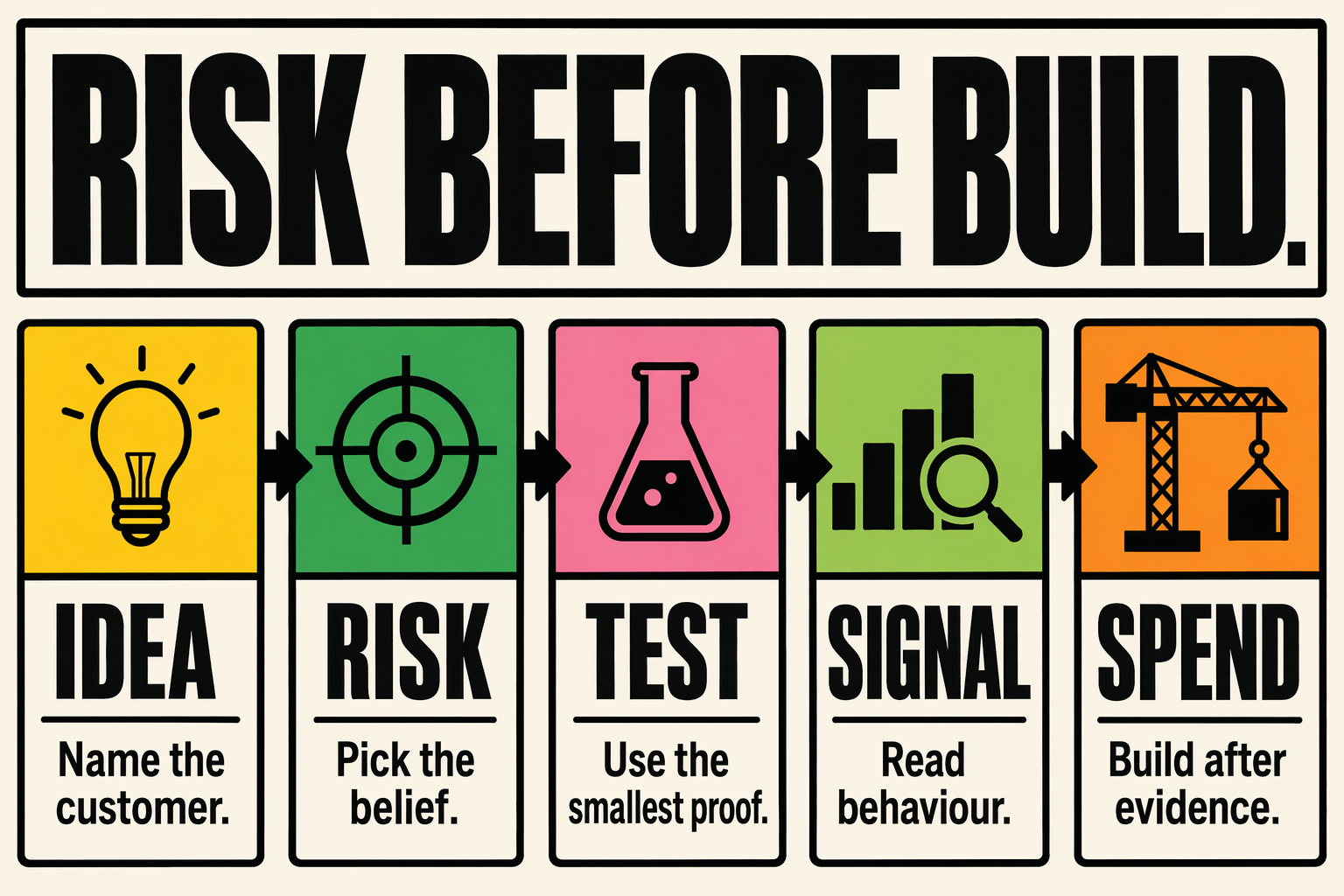
That matters because startup failure is expensive and messy. CB Insights keeps a research library of startup failure post-mortems where weak demand, cash pressure, team problems, competition, pricing, and timing appear again and again. Harvard Business School has also reported that a large share of venture-backed startups fail to return cash to investors. Read the current CB Insights research at Why Startups Fail and the Harvard report at Why Most Venture-Backed Companies Fail.
What an MVP actually proves
A Minimum Viable Product should prove movement, not opinions.
A founder does not need another survey where friends say the idea sounds interesting. A founder needs behaviour. Behaviour includes signups, paid deposits, repeated usage, booked calls, referral attempts, cancelled trials, ignored emails, abandoned carts, or angry replies from the wrong audience. Those signals hurt more than compliments, and they teach more.
The first job of an MVP is to answer a focused question:
- Is the customer real?
- Is the problem painful enough?
- Is the promise clear?
- Is the channel reachable?
- Is the price believable?
- Is the first use case narrow enough?
- Is the founder learning faster than spending?
If the MVP does not answer one of those questions, it is probably a small product build wearing a validation costume.
This is why founders should start with the Minimum Viable Product basics before choosing a build path. The definition matters because the wrong definition turns the MVP into a feature list. The right definition turns it into a test.
Why founders skip the MVP and regret it later
Founders often skip the MVP because building feels more serious than testing. A beautiful dashboard feels like progress. A full app gives the founder something to show. A large feature list makes the pitch deck look mature. The trouble starts when the market responds with silence.
Silence is expensive because it arrives after the invoices.
The founder has paid for screens, code, tools, revisions, meetings, and maybe a team. Then the first users arrive and ask for something else. Or worse, they do nothing. They do not complain, pay, share, convert, return, or care. That is the moment a founder learns the product was built around founder certainty rather than market proof.
An MVP forces the team to face the outside world earlier.
- Who acted?
- What did they do?
- What did they refuse to do?
- What did they pay for?
- What did they misunderstand?
- What did they ask for without being prompted?
- Which part of the idea survived contact with real behaviour?
The four kinds of proof every startup should seek
A strong MVP does not test everything. It tests the proof that matters first. Most early startups need four kinds of proof, and the order depends on the risk.
Useful signal: a specific segment takes action without heavy persuasion. Weak signal: broad positive feedback from people outside the buying group.
Useful signal: people sign up, book, pay, wait, refer, or return. Weak signal: people say the idea is interesting.
Useful signal: people understand the outcome and ask for the next step. Weak signal: people need a long explanation before reacting.
Useful signal: the result is delivered manually, with no-code, or with a narrow build. Weak signal: the team needs a full product before any learning happens.
The first MVP should seek the weakest missing proof. If demand is unclear, do not build a complex product. If the customer is unclear, do not polish pricing. If the offer is unclear, do not hire engineering. If delivery is unclear, do not sell a promise that the team has no practical path to fulfil.
This is also where the difference between a proof of concept, a prototype, and an MVP matters. The MVP vs prototype vs proof of concept guide explains the distinction in more detail.
The MVP is a spending filter
Early startup money carries more than a number. It includes time, focus, confidence, team energy, opportunity, and patience from everyone involved.
Every feature added before proof has a hidden cost:
- It gives the founder more to defend.
- It makes the product harder to change.
- It makes the customer harder to read.
- It spreads attention across too many assumptions.
- It delays the first honest signal.
- It creates sunk cost before the market has spoken.
An MVP protects the founder from premature commitment. It creates a smaller bet with a sharper learning target.
The word “minimum” is often misunderstood. Minimum means the smallest credible version of the test. A landing page for a high-trust B2B product still needs credibility. A concierge test for a service still needs clear delivery. A no-code tool still needs enough reliability to let the customer finish the action. Minimum is a constraint, not an excuse.
Why MVPs help bootstrapped founders even more
Bootstrapped founders feel every wrong choice faster. There is no big round to soften a bad build decision. There is no investor story to hide behind when customers ignore the offer. That pressure is painful, and it is also useful.
An MVP gives bootstrapped founders a practical way to stay close to money and reality:
- Sell before polishing.
- Use manual delivery before custom tooling.
- Use no-code before custom systems.
- Test one buyer group before broad positioning.
- Ask for payment before assuming demand.
- Track behaviour before celebrating attention.
This is the Mean CEO view of MVPs: the goal is to learn whether a business exists.
That lesson is especially useful for first-time founders, women founders, and small teams that receive too much advice and too little practical proof. An MVP does not remove risk. It makes the risk visible early enough to handle.
The MVP goes beyond software
Many founders hear MVP and imagine a small app. That is too narrow.
- A landing page with a waitlist and a clear promise.
- A fake door test where users click a feature that is not built yet, then see a transparent message or signup prompt.
- A concierge MVP where the founder manually delivers the service.
- A Wizard of Oz MVP where the interface looks automated while the back office stays manual.
- A single-feature tool that tests one job.
- A paid workshop, call, checklist, or template that tests demand for a larger offer.
- A no-code workflow stitched from forms, sheets, email, and automation tools.
The right version depends on the riskiest assumption. If the main risk is whether people want the result, a landing page or concierge test might be enough. If the main risk is whether users understand the workflow, a clickable prototype might come first. If the main risk is whether the output is useful, a manual service might teach more than software.
The site’s startup MVP validation checklist is built around that decision. Start with the assumption, then choose the smallest test that gives a signal.
What good MVP evidence looks like
Good MVP evidence is specific and hard to fake.
Weak evidence sounds like this:
- “People liked the idea.”
- “The landing page had visits.”
- “Friends said they would use it.”
- “The demo looked good.”
- “The waitlist grew after a giveaway.”
Stronger evidence sounds like this:
- “Twenty finance managers joined from cold outreach and five booked a call.”
- “Eight people paid a deposit before the tool existed.”
- “Users returned three times in the first week without reminders.”
- “Three customers asked for the same missing capability.”
- “The audience clicked the price page and still submitted the form.”
- “A manual service delivered the result, and buyers asked for the next month.”
The difference is behaviour. An MVP should produce a behavioural signal tied to the next decision.
The most common MVP mistake
The most common mistake is building an MVP that tests the team’s ability to build instead of the market’s willingness to respond.
Founders do this when they choose features before choosing the signal. They ask, “What should the first version include?” before asking, “What do we need to learn next?”
That order creates bloat.
- Name the riskiest assumption.
- Pick the customer group.
- Define the desired behaviour.
- Choose the smallest credible test.
- Set a pass, weak, and fail threshold.
- Run the test long enough to see a pattern.
- Decide from the evidence.
This work feels unglamorous and saves the founder from learning the same lesson after a full build.
How AI and no-code changed MVP work
AI and no-code tools make MVP work faster, but they also create a new trap. Founders now build too much faster.
That sounds like a joke until the team has ten generated screens, three automations, a chatbot, a dashboard, and no paying customer.
Use AI and no-code for speed, not avoidance. They are useful when they reduce the cost of a test:
- Write a landing page faster.
- Generate interview prompts.
- Create onboarding copy.
- Build a no-code form workflow.
- Summarise user calls.
- Sort feedback themes.
- Create a lightweight demo.
- Turn repeated manual steps into a temporary workflow.
They become dangerous when they help the founder skip customer contact. A founder who avoids sales with AI is still avoiding sales, just with nicer tooling.
The right question is not “How much of the product could we build this week?” The right question is “What proof do we need this week?”
How MVPs help with timing
Timing matters because startups are usually impatient in the wrong places.
They rush the build and delay the proof. They polish the product and postpone distribution. They plan a public launch while the first offer still confuses people. They hold back because the product is not ready, while the real issue is that the customer has not been tested.
An MVP changes the sequence:
- Talk to the customer before expanding the feature set.
- Test the promise before designing every screen.
- Ask for payment before assuming willingness to pay.
- Run a manual service before automating delivery.
- Measure repeat behaviour before celebrating signups.
- Compare signal strength before choosing the next spend.
This sequence also makes the founder calmer. There is less guessing. There is less drama around the big launch. There is less attachment to features because each feature has to earn its place.
A founder decision board for MVP work
Use this decision board before you build:
Use an interview-led concierge test. Track booked calls, paid pilots, and repeated pain language.
Use a landing page MVP or fake door test. Track signup rate, email quality, price-page clicks, and replies.
Use a Wizard of Oz or manual service. Track time to deliver, buyer satisfaction, and repeated requests.
Use a single-feature MVP. Track activation, return use, and task completion.
Use a paid preorder or paid pilot. Track payment, deposits, and renewal intent.
Use content, outreach, or community tests. Track qualified visits, replies, and demo requests.
This board keeps the MVP tied to one decision. The founder should not ask a landing page to prove technical feasibility, and should not ask a prototype to prove willingness to pay.
When a startup needs an MVP most
A startup needs an MVP most when one of these conditions is true:
- The founder has strong belief and weak evidence.
- The buyer group is still broad.
- The pain sounds real, but urgency is unclear.
- The product requires serious time or cash.
- The first users need behaviour change.
- The founder is choosing between several directions.
- The team is tempted to build a full version before sales.
- The audience is polite but not acting.
- The pricing model is untested.
- The founder has too many features and no signal.
If two or more are true, slow the build and sharpen the test.
When an MVP is not enough
An MVP is not a magic pass. Some ideas need more than early validation before serious spend.
Regulated health, fintech, legal, safety, and deep tech ideas need careful boundaries. A weak prototype in those areas might create legal, privacy, safety, or trust problems. The MVP still matters, but the test should be designed around the real constraint. That might mean a feasibility study, expert review, controlled pilot, or manual service with strict limits before any public product.
Also, a successful MVP does not guarantee a company. It proves that one slice of the market reacted to one offer in one context. The next job is to learn whether that signal repeats, scales, and survives a price, channel, or delivery change.
Startup Genome’s research on premature scaling is useful here. It warns that many high-growth startups fail because they scale parts of the company out of sync with real evidence. The Startup Genome report is older, but the warning is still practical: do not scale spend, hiring, channels, or infrastructure before the evidence is strong enough. Read it here: Startup Genome premature scaling report.
How to run a useful MVP this week
Here is a practical one-week version.
- Write the riskiest assumption in one sentence.
- Choose one customer group.
- Write the promise in customer language.
- Pick the smallest credible test.
- Set the signal that means “continue.”
- Set the signal that means “stop or change direction.”
- Put the offer in front of real people.
- Track behaviour, not compliments.
- Write down what changed in your belief.
- Choose the next spend from the evidence.
Keep it small enough to finish. The value of an MVP is not the artefact. The value is the decision it produces.
After the first proof question is clear, use the 80/20 rule for startup MVPs to keep scope tied to the part of the idea that creates the strongest signal.
If you want a guided path, start with the MVP for Startups contact page and describe the assumption you need to test. The better the assumption, the better the MVP method.
Build the assumption map before scope
The MVP decision needs a sharper assumption map than the usual customer-problem-solution note. The founder should write the customer group, the painful job, the trigger moment, the current workaround, the promise, the proof action, and the failure condition before choosing features. If one of those lines is missing, the MVP has no clean way to answer the question.
The risk to isolate here is spending on a bigger build before the riskiest belief has met real behaviour. That risk should be written as a sentence the team can disagree with. For example: “finance leads at seed-stage SaaS companies book a call when the offer promises a two-day budget diagnosis.” The sentence is specific enough to test. “Founders need better planning” is not.
A good assumption map also states what the test does not need. It does not need a full account system when the risk is demand. It does not need automated onboarding when the risk is trust. It does not need a polished dashboard when the risk is whether anyone cares about the result. Scope follows the assumption, not the founder’s imagination.
- Customer: name the group narrowly enough to find ten real people.
- Painful job: write the job in the customer language, not product language.
- Trigger: name the moment when the customer becomes willing to act.
- Current workaround: record what they do now, even when it is messy.
- Proof action: pick the behaviour that proves more than curiosity.
- Failure condition: decide which result means the idea needs to narrow or stop.
Choose the test method by evidence, not taste
The method should answer the evidence question. A fake door test checks whether people click, request access, or start a buying flow. A concierge test checks whether the promised result matters enough for a customer to work with you. A Wizard of Oz test checks whether the experience feels useful before the back-end exists. A single-feature build checks repeat usage when delivery needs real software.
For this topic, the practical method is usually a focused landing page, manual delivery test, prototype session, or single-feature build. That choice is useful only when the test creates a behaviour the founder can read. If the method produces vague feedback, the test is probably measuring politeness, not demand.
The research baseline supports this approach. Lean Startup material frames an MVP around validated learning with the least effort, while YC’s MVP guidance focuses on talking to users, getting first users, and iterating from real feedback. NN/g also treats an MVP as an experiment that helps teams assess whether users get meaningful value before a full-scale solution.
- Use a landing page when the risky belief is message, audience, or channel.
- Use concierge delivery when the risky belief is value, urgency, or willingness to pay.
- Use Wizard of Oz when the risky belief is experience quality before automation.
- Use a prototype when the risky belief is comprehension or workflow fit.
- Use a single feature when the risky belief is repeat usage, not first interest.
- Use the smallest credible version when the decision is continue, narrow, or stop.
Set evidence levels before the test starts
Evidence is easier to read when the levels are agreed in advance. The team should know what weak, usable, strong, and decision-ready evidence looks like before the first campaign, interview, prototype session, or payment request. Otherwise every result becomes negotiable after the fact.
The core metric for this page is qualified action from the intended customer. That metric should connect to the next spend decision. If the next move is a paid build, the evidence should include buyer urgency or repeated use. If the next move is a narrow research sprint, a smaller signal can be enough.
Do not mix every metric into one score. A founder can track many facts, but only one or two should decide the next move. The rest explain why the result happened. This distinction keeps analytics from becoming a comfort blanket.
- Weak evidence: likes, compliments, newsletter joins from the wrong audience, or survey agreement without action.
- Usable evidence: qualified replies, completed calls, waitlist joins with clear pain notes, or prototype completion.
- Strong evidence: payment intent, deposit, repeat use, referral, serious objection, or a buyer asking implementation questions.
- Decision-ready evidence: the same behaviour repeats from the intended audience under a clear promise and known acquisition source.
- Stop evidence: the audience understands the offer but does not act, objects to the core value, or keeps using the workaround.
Instrument the MVP so the signal survives
A useful MVP needs a simple measurement setup before traffic arrives. The founder should know where each visitor came from, what promise they saw, what action they took, what objection they raised, and what happened after the first touch. Without that record, the team learns less than the activity suggests.
Keep the setup plain. Use campaign tags for traffic source, a form field or CRM note for audience type, one success event, one stop event, and a weekly review log. If the test involves manual delivery, record delivery time and rework. If the test involves AI, record every correction and trust objection. If the test involves money, record price anchor, discount request, and payment friction.
Qualitative notes matter because early sample sizes are small. A founder should not pretend ten calls equal statistical certainty. Ten calls can still reveal repeated language, trigger moments, budget objections, and workflow gaps. Pair those notes with behaviour so the story does not drift into wishful interpretation.
- Track source: search, referral, community, cold outreach, partner, paid test, or direct.
- Track audience fit: exact role, company type, urgency level, and current workaround.
- Track action: click, reply, call booked, deposit, repeat use, referral, or churn.
- Track objection: price, trust, timing, authority, risk, switching effort, or missing feature.
- Track effort: setup time, delivery time, support time, manual rework, and tool cost.
- Track decision: continue, narrow, stop, or run a cleaner test.
Control cost and scope with a spend ladder
A spend ladder turns budget into learning stages. The first rung should buy clarity, not polish. The second rung should improve credibility only where the first test showed friction. The third rung should build the narrow part that repeated. This prevents a founder from jumping from idea excitement to full software spend.
For the MVP decision, the ladder should include time as well as cash. Founder hours, expert review, user recruitment, data cleanup, no-code subscriptions, design, developer time, support, security, and analytics all count. A cheap tool stack can still be expensive if it consumes weeks of attention and produces unclear evidence.
Each rung needs a release rule. Spend the next amount only when the previous signal reaches the agreed level. If the test misses the signal, spend on diagnosis instead of production. That might mean better audience targeting, clearer copy, a manual delivery pass, or a smaller workflow.
- Rung 1: problem proof with interviews, outreach, fake door, or prototype session.
- Rung 2: value proof with concierge delivery, paid call, deposit, or manual service.
- Rung 3: repeat proof with a single feature, no-code workflow, or lightly automated delivery.
- Rung 4: trust proof with onboarding, security basics, data handling, and support response.
- Rung 5: scale proof only after the signal repeats without founder heroics.
Use a worked scenario, then adapt it
A founder has a broad software idea and three possible customer groups. Instead of building the whole product, she writes one painful job, offers one narrow outcome, and tests whether the best-fit customer takes a real step. The useful move is to make the test concrete enough that another person could run it without guessing the intent. The founder writes the promise, target list, outreach text, success action, timebox, and stop rule in advance.
A practical version might run for ten to fourteen days. Day one is assumption mapping. Days two and three are customer sourcing and message writing. Days four through eight are outreach, prototype sessions, or manual delivery. The final days are for follow-up, evidence sorting, and the decision memo. This is short enough to protect momentum and long enough to catch real objections.
The memo should be blunt. It should say what happened, which audience acted, which promise failed, what cost was spent, what evidence repeated, and what the next decision is. It should not defend the founder’s favourite feature. If the evidence is mixed, the next move is a narrower test, not a bigger build.
- Write the audience list before writing the feature list.
- Write the promise as a customer outcome, not a product capability.
- Ask for a real action, even when the action is small.
- Keep the delivery method honest enough that users trust the experience.
- Review evidence on a fixed date, not whenever the result feels comfortable.
Apply the research without copying it blindly
Lean Startup Co. on Minimum Viable Product is useful because it gives this page a constraint, not because it gives a script to copy. The constraint is simple: test the thing that changes the next decision. The exact tactic depends on the customer, risk, budget, trust bar, and delivery model.
Startup Genome’s premature-scaling work is a useful warning here. Scaling behaviour can run ahead of validation. Hiring, infrastructure, feature count, marketing spend, or automation can all look like progress while the customer signal stays weak. The article should push founders back to the stage they are really in, not the stage they want to look like.
For user understanding, NN/g’s interview guidance is a reminder that interviews reveal perceptions, context, and needs. They do not replace behaviour tests. A founder can use interviews to find language and risk, then use the MVP to see whether customers act when the offer becomes real.
- Use Lean Startup Co. on Minimum Viable Product as the main outside lens for this decision.
- Use Lean Startup sources for learning-loop discipline and MVP scope.
- Use YC sources for launch speed, first users, and feedback cadence.
- Use NN/g sources for user value, interview limits, and qualitative research.
- Use Startup Genome sources as a warning against scaling before validation.
Write the decision memo before moving on
The last step is a one-page memo. The memo turns the test from activity into evidence. It should include the assumption, customer group, method, timebox, spend, signal, source mix, objections, result, and next move. If the founder cannot write those lines clearly, the test has not produced enough decision value yet.
The memo should separate facts from interpretation. “Twelve finance leads opened the page” is a fact. “Finance leads want this product” is an interpretation. “Three finance leads booked a paid diagnostic call after seeing the budget promise” is closer to a decision signal. The difference matters because early teams often talk themselves into certainty.
A useful memo ends with one action: build one narrow part, retest the promise, change the audience, change the price, improve trust, or stop. Anything longer usually means the test mixed too many assumptions at once.
- Assumption tested: one sentence.
- Audience reached: exact source and fit notes.
- Method used: landing page, concierge, prototype, Wizard of Oz, single feature, or other.
- Evidence found: actions, objections, repeats, payments, and support load.
- Decision: continue, narrow, stop, or run a cleaner test.
- Next spend: what gets funded, what stays out, and what signal must appear next.
FAQ
Why do startups need MVPs?
Startups need MVPs because early ideas are mostly assumptions. A Minimum Viable Product tests the riskiest assumption with a small, credible version of the offer before the founder commits to a larger build.
What does MVP mean for a startup?
MVP means Minimum Viable Product. In a startup context, it is the smallest credible test that helps the founder learn whether customers care enough to act.
Is an MVP only a smaller product?
No. An MVP is a learning tool. It might be a landing page, manual service, no-code workflow, fake door test, Wizard of Oz test, or single-feature product.
What should an MVP prove first?
The first proof should match the biggest risk. That risk might be demand, pricing, usage, trust, delivery, customer segment, or channel.
How small should an MVP be?
It should be small enough to test quickly and credible enough to produce real behaviour. Too small means nobody trusts it. Too large means the founder pays before learning.
Does every startup need an MVP?
Most startups need some form of early validation. The exact MVP depends on the risk, market, trust level, regulation, and cost of being wrong.
Is a landing page enough for an MVP?
A landing page is enough when the first risk is demand, message clarity, or audience fit. It is weak when the main risk is delivery, technical feasibility, or repeated usage.
What is the difference between an MVP and a prototype?
A prototype shows what something might look or feel like. An MVP tests whether customers behave in a way that supports the business idea.
What is the difference between an MVP and a proof of concept?
A proof of concept checks whether something is feasible. An MVP checks whether a customer segment reacts to the offer with meaningful behaviour.
Should an MVP include payment?
Payment is useful when willingness to pay is the risky assumption. A free waitlist is weaker, although it still helps when the first test is message or demand.
How long should an MVP test run?
It should run long enough to collect a pattern from the intended audience. A week might be enough for a narrow outreach test. A usage test might need several weeks.
What is a weak MVP signal?
A weak signal is polite interest without action. Likes, compliments, vague survey answers, and friend feedback rarely prove demand by themselves.
What is a strong MVP signal?
A strong signal is behaviour. Payment, repeated use, booked calls, referrals, qualified signups, and clear buyer objections are stronger than praise.
What happens after an MVP works?
The founder should repeat the signal, narrow the strongest segment, improve the offer, and decide which parts deserve real build effort.
What happens after an MVP fails?
The founder should inspect the failed assumption. The answer might be a different customer group, promise, channel, price, or MVP method.
Is no-code serious enough for an MVP?
Yes. No-code is serious when it helps the founder test demand, deliver value, and learn before paying for custom systems.
Should an MVP look polished?
It should look credible for the audience and risk. A consumer trust test needs more polish than a team workflow test. Credible beats fancy.
What is the biggest MVP mistake?
The biggest mistake is building features before choosing the signal. A founder should know what behaviour the MVP needs to produce before choosing the build.
How does an MVP reduce startup risk?
It reduces risk by moving the most dangerous assumptions into a smaller test. The founder learns earlier, spends less, and avoids defending features that the market never asked for.
Where should a first-time founder start?
Start with one sentence: “We believe this customer has this painful problem and takes this action when offered this result.” Then choose the smallest credible test for that sentence.
Choose the next proof before the next build
Use the directory to match your assumption to a practical MVP method, then spend on the version that evidence deserves.
Ask About My MVP