When To Pivot After An MVP
Read demand, usage, buyer intent, and the next startup decision before turning early interest into a bigger build.
The signal should help a founder choose what to test before a bigger build. The useful version connects one customer group, one risky belief, one proof signal, and one spend decision.
Use this guide to keep the MVP small, credible, and tied to behaviour. The goal is not a prettier plan. The goal is a decision that prevents wasted build effort.
The signal is useful only when it changes what a founder builds, tests, cuts, or delays. It should help the team decide whether the next move deserves time, cash, and attention.
A strong Minimum Viable Product keeps the risk visible. It asks what must be true, what proof would count, and what the founder should do when the evidence arrives.
Useful background: the MVP idea sits inside validated learning, user research and stage discipline. This guide draws on Lean Startup Co. on Minimum Viable Product, The Lean Startup method principles, Y Combinator on planning an MVP, NN/g on MVP definition, NN/g on user interviews, Startup Genome on premature scaling.
What the evidence should reveal
The signal matters when a founder has moved past a vague idea and needs a test that produces evidence. The useful question is not whether the idea sounds good. The useful question is whether a real person takes a meaningful action when the offer appears in front of them.
For MVP for Startups, the page works as a decision filter. It should help you decide what to test, what to ignore, what signal to track, and what spend to delay until the market gives a reason.
A Minimum Viable Product works best when it is narrow. Narrow does not mean lazy. It means the founder chooses the smallest credible path to learn whether the customer, problem, promise, channel, price, and delivery model deserve more attention.
The signal behind the decision
The decision matters when time, cash, confidence, or team energy is about to move into a larger build. At that point, guessing becomes expensive. A narrow test gives the founder a way to slow down the wrong spend while still moving fast enough to learn.
The best moment to use this guide is before the first serious build, before hiring a team, before adding a large feature list, or before presenting traction as proof. It is also useful after a confusing test, because unclear evidence usually means the assumption was too broad.
Use it when the next move feels obvious but the proof behind it feels thin. That tension is where many early startups waste money.
Metrics that matter before a bigger build
Use the decision board as a filter. First, name the customer group. Then write the painful job in plain language. After that, choose the assumption that would break the idea if it proved false. The test should exist only to examine that assumption.
The founder should also write a stop signal. This matters because teams often invent new reasons to continue once time and money are already spent. A stop signal protects the founder from defending a build that the market has not earned.
The final board item is the next spend. Spend should follow evidence. If the signal is weak, spend on sharper learning. If the signal repeats, spend on the narrow part that creates the behaviour.
Write who has the painful job before choosing features.
Pick the assumption that breaks the idea if it proves false.
Choose an action that proves more than polite interest.
How to read weak and strong evidence
Signals need context. A hundred signups from the wrong audience might teach less than ten qualified calls from people with the painful job. A paid deposit from one serious buyer might teach more than broad praise from friends.
Track behaviour that connects to the decision. If the decision is price, track payment intent. If the decision is usage, track repeat behaviour. If the decision is trust, track objections, cancellations, and the questions people ask before they act.
The signal should be easy to read after the test. If the founder needs a long explanation to defend the result, the test probably mixed too many assumptions at once.
Mistakes that distort the signal
The most common mistake is building a small version of the dream product before choosing the proof signal. That creates a polished artefact, but it does not always create learning. The work looks serious while the risky assumption stays untouched.
Another mistake is copying famous startup stories too literally. A story from Dropbox, Airbnb, Stripe, or Instagram sounds clean after the fact. The useful lesson is the pattern of constraint and evidence, not the exact move.
A third mistake is using tools to avoid customer contact. Tools help with speed and clarity. They should not replace conversations, offers, payments, delivery, and real market friction.
How to use this guide this week
This week, write one assumption and one proof signal. Choose one customer group. Pick the smallest credible method from the MVP for Startups directory. Set a budget line and a decision date. Then run the test with real people, not imagined users.
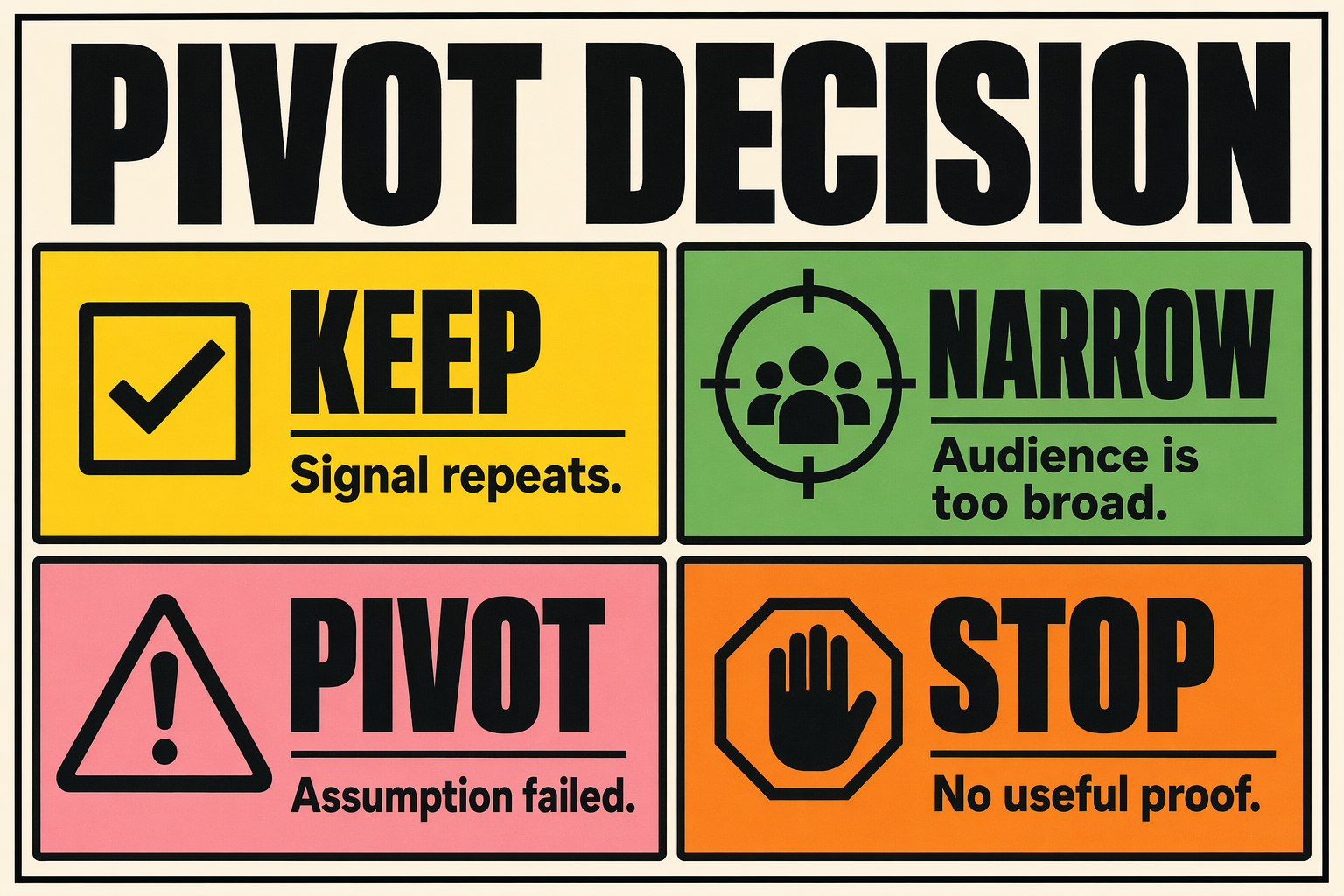
After the test, sort the evidence into three buckets: act, narrow, or stop. Act when the signal repeats. Narrow when interest appears but the audience or promise feels muddy. Stop when the painful job, buyer, or channel does not show enough movement.
For a broader foundation, use the Minimum Viable Product basics, compare MVP, prototype, and proof of concept, and keep the startup MVP validation checklist close while you choose the next test.
Build the assumption map before scope
The signal needs a sharper assumption map than the usual customer-problem-solution note. The founder should write the customer group, the painful job, the trigger moment, the current workaround, the promise, the proof action, and the failure condition before choosing features. If one of those lines is missing, the MVP has no clean way to answer the question.
The risk to isolate here is reading curiosity as demand and missing the gap between interest and action. That risk should be written as a sentence the team can disagree with. For example: “finance leads at seed-stage SaaS companies book a call when the offer promises a two-day budget diagnosis.” The sentence is specific enough to test. “Founders need better planning” is not.
A good assumption map also states what the test does not need. It does not need a full account system when the risk is demand. It does not need automated onboarding when the risk is trust. It does not need a polished dashboard when the risk is whether anyone cares about the result. Scope follows the assumption, not the founder’s imagination.
- Customer: name the group narrowly enough to find ten real people.
- Painful job: write the job in the customer language, not product language.
- Trigger: name the moment when the customer becomes willing to act.
- Current workaround: record what they do now, even when it is messy.
- Proof action: pick the behaviour that proves more than curiosity.
- Failure condition: decide which result means the idea needs to narrow or stop.
Choose the test method by evidence, not taste
The method should answer the evidence question. A fake door test checks whether people click, request access, or start a buying flow. A concierge test checks whether the promised result matters enough for a customer to work with you. A Wizard of Oz test checks whether the experience feels useful before the back-end exists. A single-feature build checks repeat usage when delivery needs real software.
For this topic, the practical method is usually a measurable demand test with source tags, one success event, and a decision date. That choice is useful only when the test creates a behaviour the founder can read. If the method produces vague feedback, the test is probably measuring politeness, not demand.
The research baseline supports this approach. Lean Startup material frames an MVP around validated learning with the least effort, while YC’s MVP guidance focuses on talking to users, getting first users, and iterating from real feedback. NN/g also treats an MVP as an experiment that helps teams assess whether users get meaningful value before a full-scale solution.
- Use a landing page when the risky belief is message, audience, or channel.
- Use concierge delivery when the risky belief is value, urgency, or willingness to pay.
- Use Wizard of Oz when the risky belief is experience quality before automation.
- Use a prototype when the risky belief is comprehension or workflow fit.
- Use a single feature when the risky belief is repeat usage, not first interest.
- Use the smallest credible version when the decision is trust the signal, retest a narrower audience, or change the promise.
Set evidence levels before the test starts
Evidence is easier to read when the levels are agreed in advance. The team should know what weak, usable, strong, and decision-ready evidence looks like before the first campaign, interview, prototype session, or payment request. Otherwise every result becomes negotiable after the fact.
The core metric for this page is repeat behaviour, qualified replies, paid intent, activation, retention, or serious objections. That metric should connect to the next spend decision. If the next move is a paid build, the evidence should include buyer urgency or repeated use. If the next move is a narrow research sprint, a smaller signal can be enough.
Do not mix every metric into one score. A founder can track many facts, but only one or two should decide the next move. The rest explain why the result happened. This distinction keeps analytics from becoming a comfort blanket.
- Weak evidence: likes, compliments, newsletter joins from the wrong audience, or survey agreement without action.
- Usable evidence: qualified replies, completed calls, waitlist joins with clear pain notes, or prototype completion.
- Strong evidence: payment intent, deposit, repeat use, referral, serious objection, or a buyer asking implementation questions.
- Decision-ready evidence: the same behaviour repeats from the intended audience under a clear promise and known acquisition source.
- Stop evidence: the audience understands the offer but does not act, objects to the core value, or keeps using the workaround.
Instrument the MVP so the signal survives
A useful MVP needs a simple measurement setup before traffic arrives. The founder should know where each visitor came from, what promise they saw, what action they took, what objection they raised, and what happened after the first touch. Without that record, the team learns less than the activity suggests.
Keep the setup plain. Use campaign tags for traffic source, a form field or CRM note for audience type, one success event, one stop event, and a weekly review log. If the test involves manual delivery, record delivery time and rework. If the test involves AI, record every correction and trust objection. If the test involves money, record price anchor, discount request, and payment friction.
Qualitative notes matter because early sample sizes are small. A founder should not pretend ten calls equal statistical certainty. Ten calls can still reveal repeated language, trigger moments, budget objections, and workflow gaps. Pair those notes with behaviour so the story does not drift into wishful interpretation.
- Track source: search, referral, community, cold outreach, partner, paid test, or direct.
- Track audience fit: exact role, company type, urgency level, and current workaround.
- Track action: click, reply, call booked, deposit, repeat use, referral, or churn.
- Track objection: price, trust, timing, authority, risk, switching effort, or missing feature.
- Track effort: setup time, delivery time, support time, manual rework, and tool cost.
- Track decision: continue, narrow, stop, or run a cleaner test.
Control cost and scope with a spend ladder
A spend ladder turns budget into learning stages. The first rung should buy clarity, not polish. The second rung should improve credibility only where the first test showed friction. The third rung should build the narrow part that repeated. This prevents a founder from jumping from idea excitement to full software spend.
For the signal, the ladder should include time as well as cash. Founder hours, expert review, user recruitment, data cleanup, no-code subscriptions, design, developer time, support, security, and analytics all count. A cheap tool stack can still be expensive if it consumes weeks of attention and produces unclear evidence.
Each rung needs a release rule. Spend the next amount only when the previous signal reaches the agreed level. If the test misses the signal, spend on diagnosis instead of production. That might mean better audience targeting, clearer copy, a manual delivery pass, or a smaller workflow.
- Rung 1: problem proof with interviews, outreach, fake door, or prototype session.
- Rung 2: value proof with concierge delivery, paid call, deposit, or manual service.
- Rung 3: repeat proof with a single feature, no-code workflow, or lightly automated delivery.
- Rung 4: trust proof with onboarding, security basics, data handling, and support response.
- Rung 5: scale proof only after the signal repeats without founder heroics.
Use a worked scenario, then adapt it
A founder gets a list of signups but cannot tell whether they came from curiosity or pain. She tags each source, asks for one concrete action, and checks which audience repeats the behaviour without extra persuasion. The useful move is to make the test concrete enough that another person could run it without guessing the intent. The founder writes the promise, target list, outreach text, success action, timebox, and stop rule in advance.
A practical version might run for ten to fourteen days. Day one is assumption mapping. Days two and three are customer sourcing and message writing. Days four through eight are outreach, prototype sessions, or manual delivery. The final days are for follow-up, evidence sorting, and the decision memo. This is short enough to protect momentum and long enough to catch real objections.
The memo should be blunt. It should say what happened, which audience acted, which promise failed, what cost was spent, what evidence repeated, and what the next decision is. It should not defend the founder’s favourite feature. If the evidence is mixed, the next move is a narrower test, not a bigger build.
- Write the audience list before writing the feature list.
- Write the promise as a customer outcome, not a product capability.
- Ask for a real action, even when the action is small.
- Keep the delivery method honest enough that users trust the experience.
- Review evidence on a fixed date, not whenever the result feels comfortable.
Apply the research without copying it blindly
NN/g on user interviews is useful because it gives this page a constraint, not because it gives a script to copy. The constraint is simple: test the thing that changes the next decision. The exact tactic depends on the customer, risk, budget, trust bar, and delivery model.
Startup Genome’s premature-scaling work is a useful warning here. Scaling behaviour can run ahead of validation. Hiring, infrastructure, feature count, marketing spend, or automation can all look like progress while the customer signal stays weak. The article should push founders back to the stage they are really in, not the stage they want to look like.
For user understanding, NN/g’s interview guidance is a reminder that interviews reveal perceptions, context, and needs. They do not replace behaviour tests. A founder can use interviews to find language and risk, then use the MVP to see whether customers act when the offer becomes real.
- Use NN/g on user interviews as the main outside lens for this decision.
- Use Lean Startup sources for learning-loop discipline and MVP scope.
- Use YC sources for launch speed, first users, and feedback cadence.
- Use NN/g sources for user value, interview limits, and qualitative research.
- Use Startup Genome sources as a warning against scaling before validation.
Write the decision memo before moving on
The last step is a one-page memo. The memo turns the test from activity into evidence. It should include the assumption, customer group, method, timebox, spend, signal, source mix, objections, result, and next move. If the founder cannot write those lines clearly, the test has not produced enough decision value yet.
The memo should separate facts from interpretation. “Twelve finance leads opened the page” is a fact. “Finance leads want this product” is an interpretation. “Three finance leads booked a paid diagnostic call after seeing the budget promise” is closer to a decision signal. The difference matters because early teams often talk themselves into certainty.
A useful memo ends with one action: build one narrow part, retest the promise, change the audience, change the price, improve trust, or stop. Anything longer usually means the test mixed too many assumptions at once.
- Assumption tested: one sentence.
- Audience reached: exact source and fit notes.
- Method used: landing page, concierge, prototype, Wizard of Oz, single feature, or other.
- Evidence found: actions, objections, repeats, payments, and support load.
- Decision: continue, narrow, stop, or run a cleaner test.
- Next spend: what gets funded, what stays out, and what signal must appear next.
Connected guides
FAQ
What should this guide help me decide?
The signal should turn a broad idea into one practical next move. The useful version names one assumption, one customer group, one proof signal, and one spend decision.
Why does this matter for startups?
Early teams often spend before they know which belief is risky. A clear test keeps the founder focused on evidence, scope, cost, and customer behaviour.
When should a founder use this guide?
Use it when the next spend depends on a belief that has not met real customer behaviour yet. It is most useful before a full build, hiring push, or major launch.
What should the first test prove?
It should prove the riskiest assumption. That risk might be demand, willingness to pay, technical feasibility, trust, delivery effort, or repeat usage.
How small should the test be?
The test should be small enough to finish quickly and credible enough to create honest behaviour. A tiny test with no trust gives weak data. A big build hides the lesson inside cost.
Which metric matters most?
The best metric is the one tied to the next decision. Signups, paid deposits, repeated usage, booked calls, referrals, qualified replies, and churn all matter in different contexts.
What is a weak signal?
A weak signal is interest without action. Compliments, likes, vague survey answers, and friendly encouragement rarely justify a bigger build by themselves.
What is a strong signal?
A strong signal changes behaviour. Payment, repeated use, serious buyer objections, referrals, and clear demand from the intended audience carry more weight.
How does this relate to a Minimum Viable Product?
A Minimum Viable Product is the test container. This guide helps define what the container should prove and which parts belong outside the first version.
Should the MVP include payment?
Payment helps when price and urgency are the risky assumptions. If the risk is message clarity or usability, another signal might come first.
Is no-code enough for this?
No-code is enough when it creates a credible customer experience and lets the founder learn faster than custom software. It is weak when it hides the hard delivery problem.
Should AI be used in this MVP?
AI helps when it speeds research, writing, sorting, or delivery without hiding the customer signal. Human review should stay close to anything that affects trust, safety, or payment.
How long should the test run?
A narrow outreach or landing page test might run for days. A usage or retention test might need several weeks. The timebox should match the behaviour being measured.
What should be written down before starting?
Write the customer group, painful job, assumption, test method, success signal, stop signal, budget line, and decision date. That record keeps the team honest.
What happens if the signal is unclear?
Treat unclear evidence as a reason to narrow the test. Change one variable at a time: audience, promise, channel, price, or delivery method.
What happens if the test works?
Repeat the signal with a slightly broader audience, then decide which feature, workflow, or delivery step deserves more spend.
What happens if the test fails?
Study which assumption failed. A failed MVP might point to the wrong customer, weak urgency, unclear promise, bad channel, or a test that lacked credibility.
What is the biggest mistake?
The biggest mistake is treating the topic as a checklist instead of a decision. The work only matters when it changes what the founder builds, cuts, sells, or postpones.
How does this fit the MVP for Startups directory?
The directory helps match the assumption to a practical MVP method, then ties that method to budget, timeline, and proof signals.
Where should a first-time founder start?
Start with one sentence: this customer has this painful job and takes this action when offered this result. Then choose the smallest credible test for that sentence.
Choose the next proof before the next build
Use the directory to match the risky assumption to a practical MVP method, budget range, and signal.